
EV Charging Infrastructure Market Size and Forecast 2025–2033
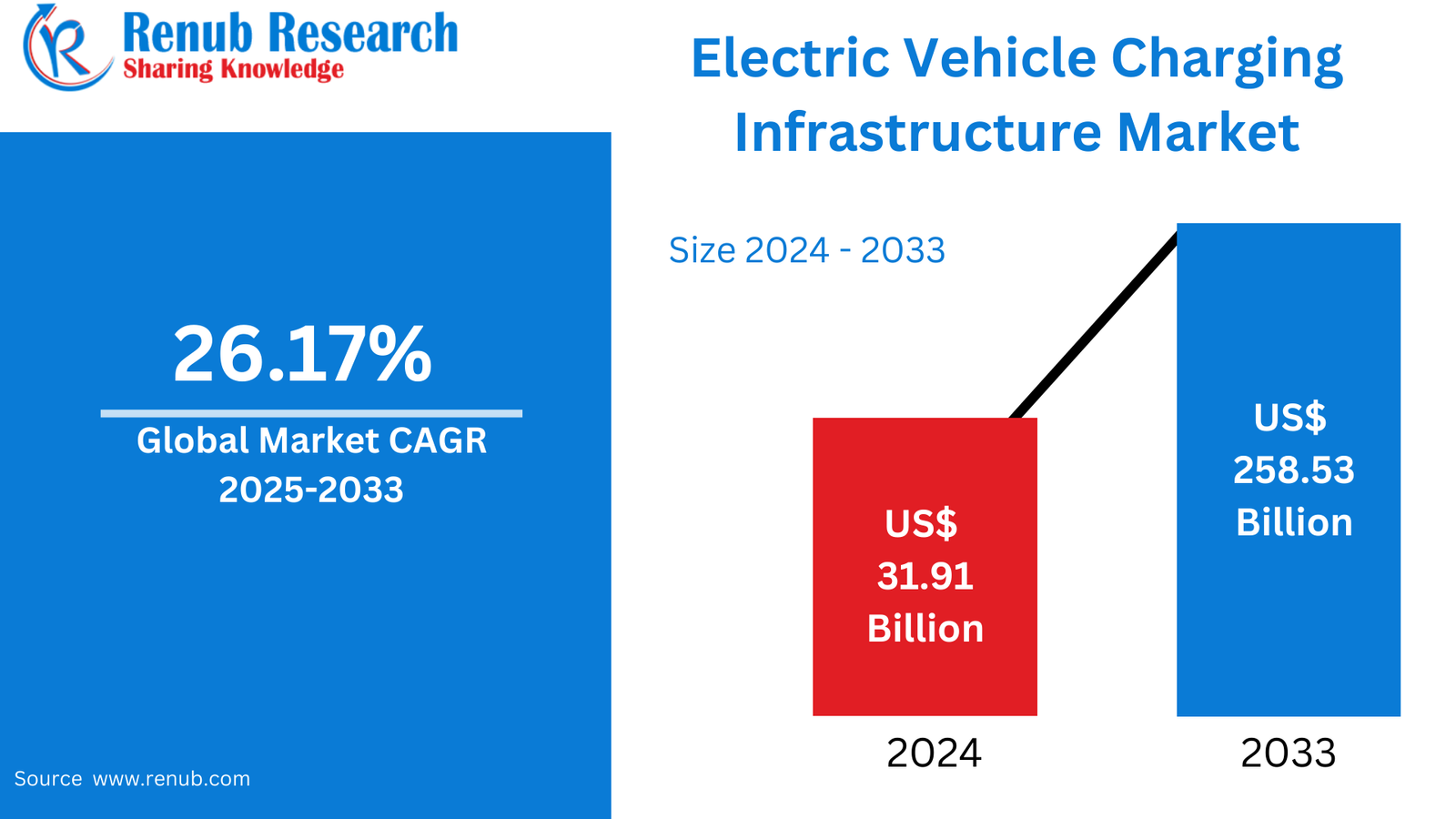
The Global Electric Vehicle (EV) Charging Infrastructure Market is set for rapid expansion, projected to surge from US$ 31.91 billion in 2024 to approximately US$ 258.53 billion by 2033, growing at an impressive CAGR of 26.17% between 2025 and 2033. This unprecedented growth is fueled by increasing EV adoption worldwide, strong government initiatives supporting decarbonization, large-scale investments in charging networks, and continuous technological advancement in fast-charging systems and smart grid integration. With consumers demanding “charge anywhere, anytime” convenience, the development of accessible, reliable, and high-speed charging infrastructure remains integral to accelerating global electric mobility.
Electric Vehicle Charging Infrastructure Market Overview
EV charging infrastructure refers to the interconnected ecosystem of charging stations, power systems, software platforms, and grid management technology that enables electric vehicles to recharge efficiently. Charging solutions typically fall into three categories:
- Level 1 (Slow Charging) – basic AC charging, commonly used in residential settings
- Level 2 (Fast AC Charging) – widely used in commercial, workplace, and public environments
- DC Fast Charging / Rapid Charging – enables significantly reduced charging time for long-distance and high-usage EVs
Infrastructure deployment spans residential homes, workplaces, highways, public parking areas, fleet depots, shopping centers, and transport hubs. Modern smart charging systems feature mobile connectivity, payment integration, load balancing, remote monitoring, and renewable energy synchronization—making EV charging smarter, safer, and more efficient.
As countries intensify efforts to reduce emissions and transition to sustainable transportation, governments in Europe, North America, and Asia-Pacific are investing heavily in nationwide charging networks. Private companies, utilities, and automotive manufacturers are likewise collaborating to expand charging accessibility, increase speed, and address range anxiety—one of the primary barriers to EV adoption.
Download Free Sample Report:https://www.renub.com/request-sample-page.php?gturl=ev-charging-infrastructure-market-company-analysis-p.php
Key Growth Drivers of the EV Charging Infrastructure Market
Rising Global Adoption of Electric Vehicles
With automakers accelerating electrification strategies and consumers shifting toward eco-friendly transportation, EV adoption has increased significantly. Growing awareness of environmental benefits, declining battery costs, improving driving range, and enhanced government incentives collectively support increasing demand for charging infrastructure.
Strong Government Policies and Funding Support
Governments worldwide are implementing supportive regulatory frameworks, subsidies, installation incentives, emission reduction mandates, and national electrification roadmaps. Large-scale infrastructure funding in countries such as the United States, Germany, China, the United Kingdom, India, and Norway is advancing EV readiness and enabling faster deployment of public charging stations.
Technological Advancements and Smart Charging Solutions
Advancements in ultra-fast charging systems, wireless charging, grid integration, AI-based load management, and renewable-powered charging stations improve user convenience while minimizing grid strain. Smart platforms enable real-time monitoring, predictive maintenance, dynamic pricing, and seamless digital payment solutions, further strengthening consumer experience and operational efficiency.
Market Challenges
Despite promising prospects, challenges persist including high installation and maintenance costs, grid capacity constraints, land availability, interoperability concerns, cybersecurity risks, and uneven charging station distribution across regions. However, technological innovation, public–private partnerships, and strategic policy reforms are progressively addressing these restraints.
Leading Companies in the EV Charging Infrastructure Market
The competitive landscape features major global technology giants, EV solution providers, energy companies, and infrastructure innovators. Key players include ABB Ltd., ChargePoint Inc., Blink Charging Co., Eaton Corporation, Tesla Inc., Webasto Group, Schneider Electric, Siemens, Delta Electronics, Robert Bosch GmbH, EVBox (Engie), ClipperCreek, Exicom Tele-Systems, Star Charge, Wallbox, Fortum Charge & Drive, Pod Point, Efacec, Leviton, and Heliox, among others. These companies focus on expanding charging networks, upgrading fast-charging capabilities, investing in digital platforms, and leveraging renewable integration to maintain competitive leadership.
Top Manufacturers Driving Market Expansion
Industry leaders like ABB, ChargePoint, Blink Charging, Eaton, and Tesla continue to shape infrastructure evolution through robust portfolios spanning AC chargers, DC fast chargers, ultra-fast units, smart charging networks, and grid-connected technologies. These companies also collaborate with governments, fleet operators, real estate developers, and energy utilities to accelerate infrastructure accessibility.
Significant Product Launches Strengthening Market Outlook
Notable developments—such as Webasto introducing the TurboConnect charger lineup and Schneider Electric launching Charge Pro to enhance commercial charging ecosystems—underscore increasing emphasis on scalable, efficient, and future-ready charging platforms. These innovations enhance charging reliability while supporting fleet electrification, residential adoption, and commercial infrastructure deployment.
Strategic Market Strength and SWOT Insights
Companies like Siemens benefit from advanced electrification expertise, integrated smart grid capabilities, and global infrastructure networks—positioning them as critical partners in global EV ecosystem expansion. Meanwhile, Delta Electronics leverages power electronics strength, high-efficiency charging technology, and vertically integrated production to deliver scalable charging solutions with strong reliability and cost advantage.
Recent Developments Reinforcing Market Growth
Key advancements such as EVBox initiating U.S.-based production of modular fast chargers, and Bosch enhancing EV manufacturing technology capabilities through additive manufacturing initiatives, highlight ongoing capacity expansion and regional manufacturing localization trends. These developments enhance supply resilience while meeting rising demand in strategic EV growth markets.
Sustainability Commitments Enhancing Market Credibility
Companies including ClipperCreek and Exicom Tele-Systems are prioritizing sustainable manufacturing, renewable energy-enabled charging, low-emission operations, and energy-efficient designs. Their sustainability-focused strategies support global clean mobility goals while encouraging broader EV ecosystem adoption.
Market Segmentation Overview
The EV Charging Infrastructure Market analysis encompasses:
- Historical Performance & Future Outlook
- Market Share Assessments Across Leading Companies
- Company Profiles & Strategic Reviews including business models, governance structure, sustainability performance, partnerships, investments, product benchmarking, SWOT evaluations, and revenue insights
Conclusion: Strong Future Outlook for the EV Charging Infrastructure Market
The EV Charging Infrastructure Market is on a strong upward trajectory through 2033, driven by accelerating electrification of transportation, expanding government policy support, large-scale infrastructure investments, and rapid technological innovation. As ultra-fast, intelligent, and renewable-powered charging networks continue to develop, accessibility and reliability will significantly improve—reducing range anxiety and strengthening consumer confidence in electric mobility. With continued collaboration between governments, technology leaders, energy providers, and automakers, the EV charging ecosystem will remain a cornerstone in shaping a cleaner, smarter, and sustainable global transportation future.
