
Everyone talks about AI in advertising. Few share real numbers. Early adopters running ChatGPT ad campaigns are seeing measurable differences in creative output, testing velocity, and cost efficiency. But the results are not magic. They follow specific patterns.
This post breaks down what is working, what is not, and what the data actually shows.
The Hype Versus the Reality
Most articles about AI advertising promise overnight transformation. The reality is more nuanced. AI does not fix bad offers or broken funnels. What it does is accelerate the execution layer. Teams that already have strong fundamentals see outsized gains. Teams with weak positioning see faster failure.
The distinction matters. AI amplifies what you already do. It does not replace strategy.
“AI made our good campaigns great and our bad campaigns fail faster. Both outcomes saved us money.”
What Early Adopters Report Across Key Areas
Creative Production Speed
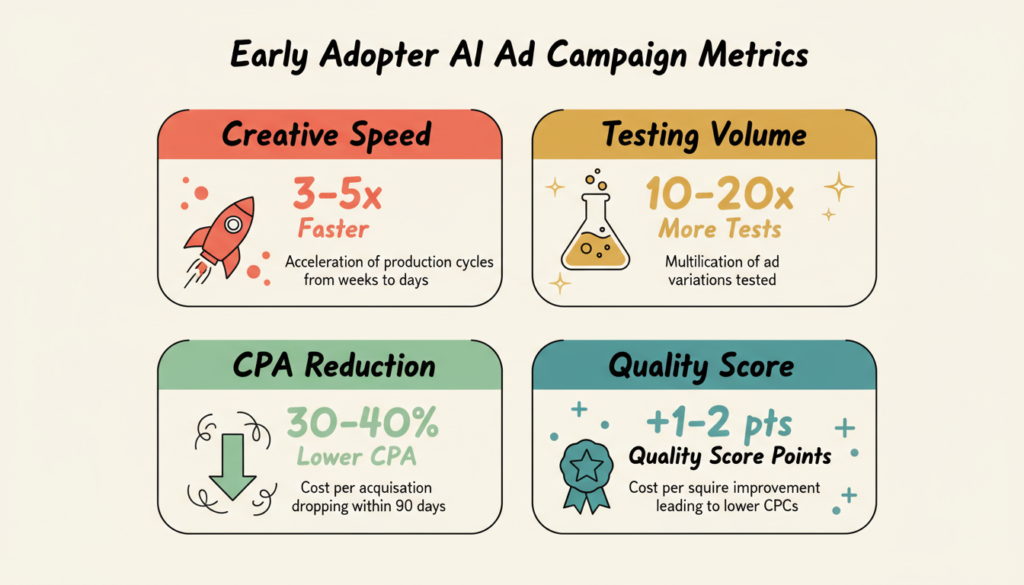
Teams using AI for ad creative report 3-5x faster production cycles. A campaign that took two weeks to build and launch now takes three days. The bottleneck shifted from copywriting to approval workflows.
Testing Volume and Learning Speed
Early adopters test 10-20x more ad variations than manual teams. More tests mean faster learning. Faster learning means lower costs. One startup reported finding their best-performing headline in four days instead of the usual six weeks.
Cost Per Acquisition Improvements
The most consistent result across early ChatGPT ad campaigns is a 30-40% reduction in CPA within 90 days. This comes from two sources: better creative performance and faster elimination of underperformers. Teams using chatgpt advertising tools cut waste faster because AI identifies losing ads before they consume significant budget.
Quality Score Gains
Better ad relevance leads to higher quality scores. Higher quality scores lead to lower CPCs. Several early adopters report quality score improvements of 1-2 points across their top campaigns. On competitive keywords, that translates to 15-25% lower cost per click.
How to Replicate These Results
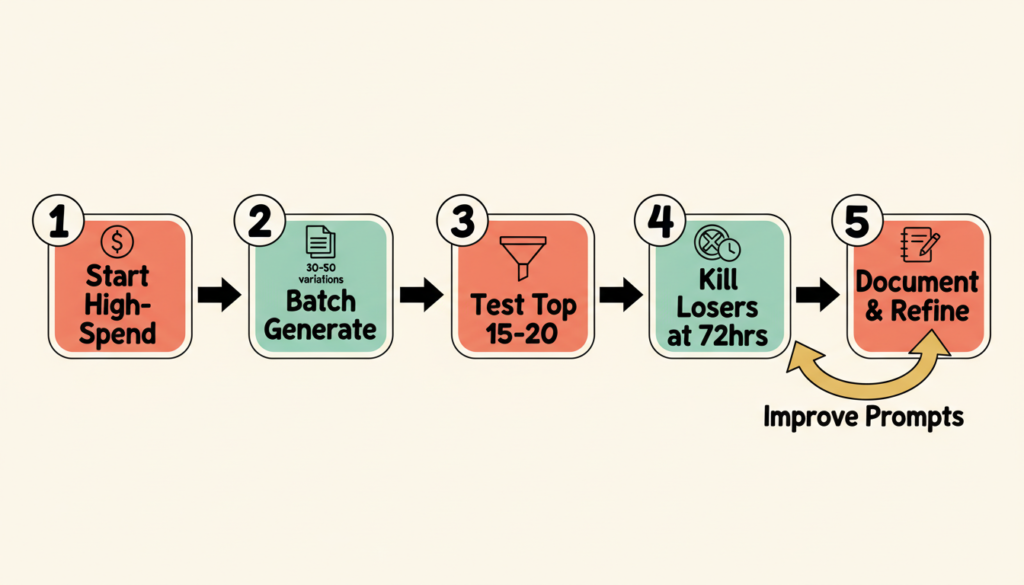
Start with your highest-spend campaigns. These have the most data and the most room for improvement. A 10% efficiency gain on a high-spend campaign beats a 50% gain on a campaign spending next to nothing.
Generate creative in batches, not one-offs. Use AI to produce 30-50 ad variations at once. Filter for brand alignment. Test the top 15-20. This approach surfaces winners that you would never have written manually.
Measure velocity, not just performance. Track how many experiments you run per week. Early adopters who ran more experiments found winners faster. The number of tests matters as much as the results of each test. Platforms built around chatgpt advertising make high-volume testing operationally feasible.
Kill losers fast. Set a rule: if an ad does not beat the control within 72 hours and 200 impressions, pause it. AI makes it cheap to create replacements. Do not let underperformers linger out of hope.
Document what AI gets wrong. Every AI tool has blind spots. Track the patterns. Maybe it writes weak CTAs. Maybe it misses your brand voice. Feed these observations back into your prompts and guidelines. The system improves when you do.
Where This Goes Next
The early adopter window is closing. What felt like an experiment in 2024 is becoming standard practice in 2026. Companies that waited are now scrambling to catch up.
The data is clear. Teams running AI-powered ad campaigns produce more creative, test faster, and reduce acquisition costs by 30-40%. These are not outliers. They are the emerging baseline.
Your competitors who adopted early are now on their second or third iteration. They have refined their prompts, built internal playbooks, and trained their teams. The compounding advantage grows every quarter.
Waiting for the technology to mature is a losing strategy. The technology is mature enough. The question is whether you are willing to change your workflow. The teams that adapted first are not looking back. They are too busy scaling.
https://www.diginewsfeed.com/bnb-chain-store-of-value-why-binarium-is-the-bnb-bitcoin/
