

Introduction
For decades, educators have searched for ways to make learning more engaging, more personal, and more effective. Worksheets gave way to digital tools, and digital tools have evolved into immersive learning experiences. Today, AI-powered game-based learning is reshaping classrooms around the world, offering a powerful blend of motivation, personalization, and data-informed instruction. This emerging approach isn’t just modernizing education – it is redefining what learning can look like.
Definition
Game-Based Learning (GBL) is an educational approach that uses game elements – such as challenges, rewards, storytelling, and interactive problem-solving – to teach knowledge or skills in an engaging and motivating way. In GBL, learners actively participate in game-like experiences that promote deeper understanding, encourage experimentation, and support mastery through feedback and iteration.
Why Game-Based Learning Works
Game-based learning (GBL) is built on a simple idea: students learn best when they want to learn. Games provide structure, clear goals, instant feedback, and rewards—all elements that foster intrinsic motivation. When students assume the role of explorers, problem solvers, or strategists, they immerse themselves in the learning experience rather than passively receiving information.
Traditional GBL already enhances engagement, but the introduction of artificial intelligence takes this model significantly further. AI brings adaptability, personalization, and real-time assessment into the mix, enabling educators to deliver experiences tailored to each student’s needs.
How AI Enhances Game-Based Learning
1. Personalized Learning Paths
In conventional classrooms, providing individualized instruction for every student is nearly impossible. AI changes that. Machine learning algorithms analyze student behavior—how long they take to solve a puzzle, where they get stuck, what strategies they use—and dynamically adjust the game’s difficulty and content.
This creates a learning path that evolves with the student:
- Struggling learners receive scaffolding and extra practice.
- Advanced learners encounter more complex challenges.
- Students with unique learning styles receive content matched to their preferences.
As a result, every learner stays engaged in a zone of achievable challenge.
2. Real-Time Feedback and Assessment
One of the greatest strengths of AI-powered systems is their ability to provide continuous assessment without disrupting gameplay. Instead of waiting for quizzes or exams, educators gain insights into student learning through detailed analytics dashboards.
AI can track:
- Concept mastery
- Patterns of errors
- Time spent on each task
- Progress toward learning standards
This allows teachers to respond quickly – re-teaching a concept to some students while allowing others to move ahead. The learning process becomes fluid rather than fixed.
3. Intelligent NPCs and Dynamic Storytelling
Games often use NPCs (non-player characters) to guide players, provide challenges, or deliver narrative elements. AI elevates NPCs from scripted characters to responsive digital companions. These characters can:
- Give hints tailored to individual learners
- Adapt their dialogue based on student progress
- Ask questions that stimulate critical thinking
- Provide emotional support or motivation
Dynamic storytelling also makes educational games more immersive. The storyline can shift based on student decisions, turning learning into an interactive narrative rather than a linear experience.
4. Inclusive Learning Experiences
Not every learner thrives in traditional classroom settings. AI-powered games can help ensure accessibility by adjusting elements such as:
- Reading level
- Audio narration
- Visual contrast
- Speed of play
Additionally, students who may feel anxious participating in class often find confidence in game-based environments, where they can learn through exploration and low-stakes experimentation.
Classroom Examples: AI at Work
AI-powered game-based learning is already making an impact in schools worldwide.
STEM Learning Through Adaptive Puzzles:
Imagine a math game where students help a robot rebuild its city. As students solve geometry or algebra puzzles, AI analyzes their reasoning and adjusts the next challenge. Students who excel move on to higher-level concepts, while those who struggle receive guided hints and scaffolded tasks, all within the game’s world.
Language Learning with Conversational AI:
Language-learners can interact with AI-driven avatars capable of holding natural conversations. These digital partners adapt to the learner’s vocabulary, grammar, and pronunciation, creating an immersive environment that mimics real-world communication.
History and Social Studies Through Interactive Simulations:
Students can step into historical eras, making choices that shape events. AI ensures that each decision leads to meaningful, accurate consequences while adapting the depth of information provided. This transforms history from memorization into experiential learning.
Benefits for Teachers and Schools
While students gain engagement and personalization, educators gain tools that simplify and enhance instruction.
1. Data-Driven Decision Making
Educators no longer need to guess which students need help – AI provides clarity. Teachers can quickly identify:
- Who has mastered the material
- Who needs intervention
- Which concepts are causing widespread confusion
This allows for more effective small-group instruction and differentiated learning.
2. Reduced Administrative Burden
AI can automate mundane tasks such as:
- Grading
- Progress tracking
- Assignment customization
This frees teachers to focus on meaningful interactions with students.
3. Professional Development and Support
Some systems include AI-driven recommendations for teachers, offering instructional strategies or lesson modifications based on classroom data. This acts like a digital teaching assistant, providing ongoing support.
Challenges and Considerations
As promising as AI-powered GBL is, it comes with challenges that educators and policymakers must address.
Equity and Access:
Schools with limited resources may struggle to obtain the necessary technology. Ensuring equitable access requires investment in devices, infrastructure, and teacher training.
Data Privacy:
AI systems collect extensive data on student behavior. Safeguarding this data is essential. Schools must adopt strict policies regarding data storage, sharing, and usage.
Teacher Training:
AI-powered tools are only effective when educators understand how to use them. Professional development must accompany any technological implementation.
Maintaining a Balanced Approach:
While games can be powerful, they shouldn’t replace all instructional methods. The goal is to enhance learning, not to gamify every aspect of school.
The Future of AI Game-Based Learning
As AI continues to advance, classrooms will see even more innovative applications:
- VR and AR games that put students inside immersive worlds
- Emotion-aware AI that adapts gameplay based on student frustration or excitement
- Collaborative AI-mediated games that teach teamwork and communication
- Predictive analytics that anticipate learning challenges before they arise
We are moving toward fully adaptive learning ecosystems where AI works alongside teachers to support every learner in real time.
Growth Rate of Game Based Learning Market
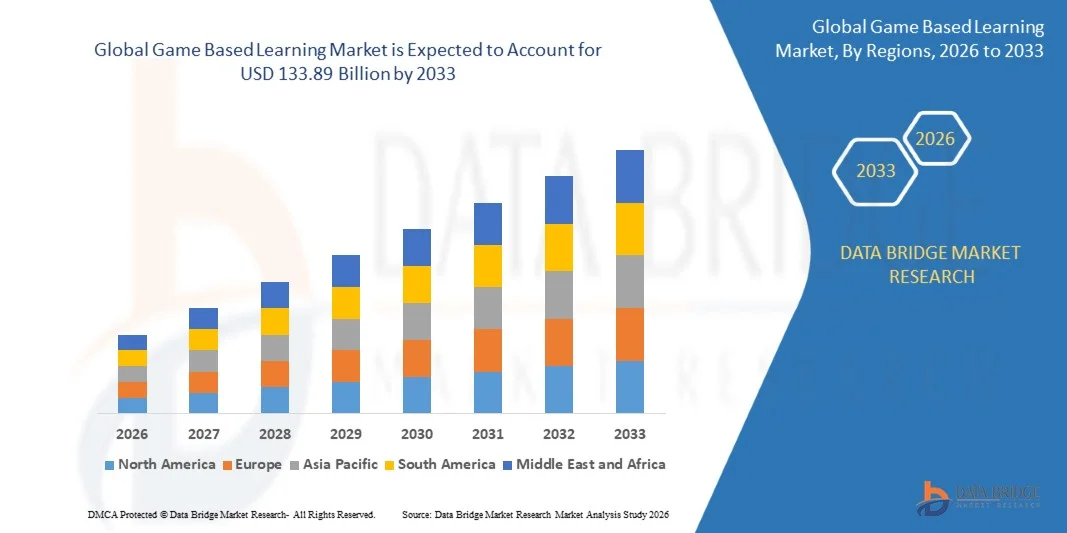
According to Data Bridge Market Research, the size of the worldwide Game-Based Learning Market was estimated at USD 26.59 billion in 2025 and is projected to grow at a compound annual growth rate (CAGR) of 22.39% to reach USD 133.89 billion by 2033.
Learn More: https://www.databridgemarketresearch.com/reports/global-game-based-learning-market
Conclusion
AI-powered game-based learning is not just a technological trend – it’s a paradigm shift. Around the world, classrooms are transforming into dynamic environments where students learn through exploration, creativity, and play. By combining the motivational power of games with the intelligence of AI, educators can create inclusive, personalized, and deeply engaging experiences that prepare students for the complexities of the future.
