

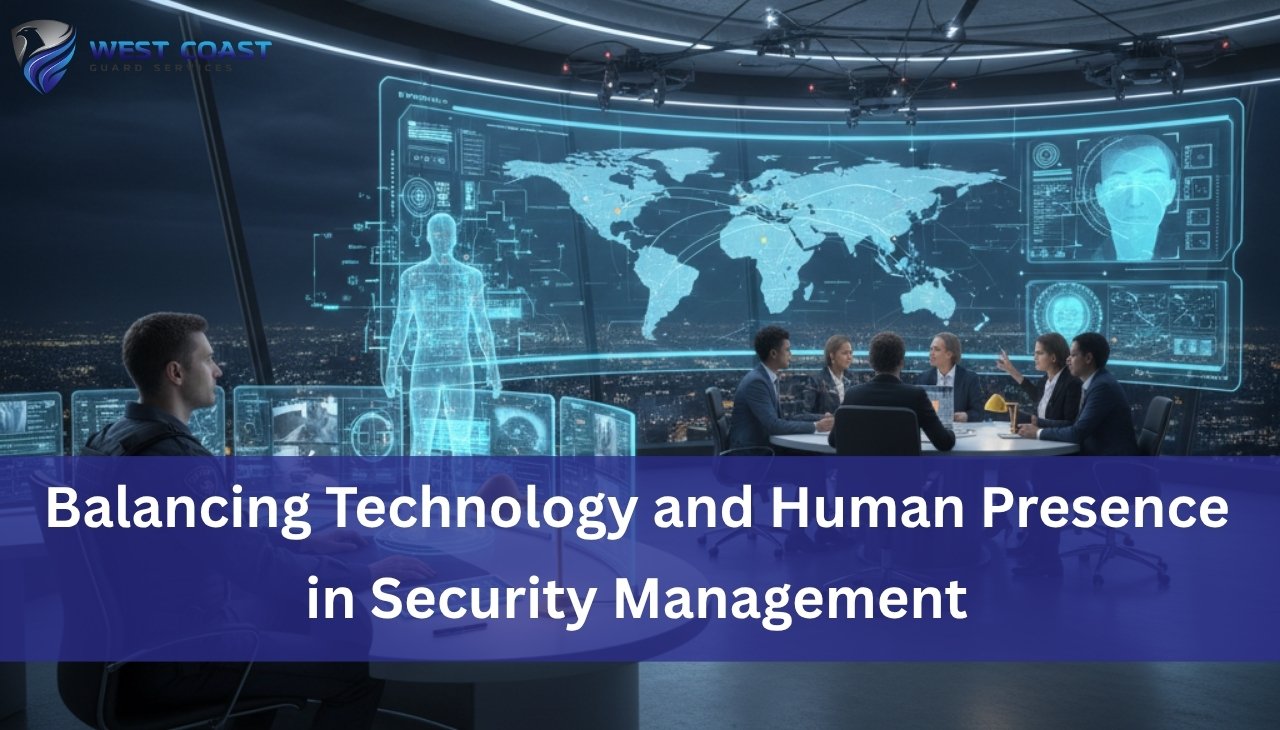
Security is changing rapidly as companies seek more intelligent ways to protect individuals and assets. The most common question posed by many companies is how to strike a balance between Technology and human guards in security, as digital tools are becoming increasingly sophisticated.
Why bridging the Technological and human aspects of security has become a necessity for modern organizations. Even though smart systems increase the speed and accuracy of the process, human judgment is unreplaceable. In addition, companies desire both intimate safety and safety backed by technology.
Due to this reason, hybrid security models are increasing rapidly. These models integrate both human intelligence and digital surveillance to form greater security management.
Why Human Presence Still Matters in Modern Security
Human guards are still an important component of protection, even with advanced tools. Security cameras do not replace security guards; people always ask whether they do, but to no effect. Humans think.
Furthermore, guards interpret feelings, body language, and tone, which machines cannot fully process. In cases of conflict, humans can quickly defuse tense situations.
Moreover, professional officers are immediately available in the event of an emergency.
How Technology Supports Security Officers Every Day
Intelligent security devices and sensors help detect threats earlier. Additionally, access control systems minimize unauthorized access,, and real-time threat-detection applications provide real-time updates via monitoring software.
Since the technology handles most time-consuming tasks, such as scanning footage or developing automated notifications, the guards have time to focus on action and decision-making.
The Benefits of Combining Digital Tools with Human Guards
Swift reaction in times of need.
Enhanced surveillance with live surveillance stations.
Better patrol routes incorporating mobile patrols.
Wiser choices with the aid of security analytics.
Better risk forecasting and reaction.
Fewer blind spots due to AI + human monitoring.
How Hybrid Security Models Work
Many companies now prefer hybrid systems, and they often ask how hybrid security models work. The structure is simple.
Manned security services guard access points, communicate with visitors, and react to problems.
Simultaneously, the surveillance and AI-based automated alarms keep the environment under control. Machines handle scanning and detection, while humans handle analysis. This multi-level method prevents threats at the beginning.
Besides, hybrid models are versatile. They can be expanded or reduced by businesses as needed. Consequently, hybrid security offers power and flexibility.
The Role of Human Decisions in a Tech-Driven Environment
The role of human decision-making in tech-based security remains very critical even in highly automated settings. Technology identifies action, but humans are aware of intentions.
For example, AI can alert when a person walks slowly near an entrance. Nonetheless, an experienced officer would be able to know whether the act is suspicious or not dangerous.
Moreover, the officers can recognize emotional responses, nervousness, or possible aggressive messages that the machine cannot assess with certainty.
Why Technology Cannot Fully Replace Security Guards
Technology is mighty, although it cannot substitute human presence. Machines have no way to comfort a scared human being or even to cool down an angry argument. On top of that, criminals tend to keep abreast of technology.
Due to these capabilities, companies still use human beings. That is why the question of how to utilize Technology without depriving human guards is one of the priority questions in contemporary security management.
Best Practices for Balancing Technology and Human Presence
It is not about technology and human beings. Rather, they should be combined appropriately.
Train Guards: Train the Digital Tools
Contemporary police officers need to know about gadgets, applications, and surveillance solutions. Training enhances communication more quickly and precisely.
Use Live Monitoring and Communication
Instant messaging applications and incident reporting systems keep the teams informed. Besides, supervisors can have real-time visibility.
Carry out risk assessments regularly
The companies use risk assessment and response tools to regularly analyze weak points. This makes systems up to date.
Integrate Physical Surveillance with Smart Surveillance.
Tech covers large areas. Officers cover complex spaces. Collectively, they eliminate blind spots.
How Smart Surveillance increased by Daily Patrols
Cameras survey wide areas, whereas humans secure narrow areas: corridors, loading platforms, and parking facilities.
Additionally, AI only notifies in the event of an unusual event. This enhances efficiency since the officers work in high-risk areas.
Additionally, the behavioral threat recognition systems enable guards to identify threats early. Consequently, patrols are made more tactical. Rather than lawlessly wandering around, the guards are aware of the places to visit and the timing.
Conclusion
Hybrid systems offer high class benefits by combining digital precision with human intelligence. These methods make businesses better prepared for emerging threats as they use them.
Suppose your company requires trusted protection and hybrid security services. In that case, West Coast Guard is the best guard company in Los Angeles that offers effective, advanced, and human-centered security solutions.
