

Global Defibrillator Market Companies Analysis – Size, Outlook, Competitive Positioning, and Strategic Insights
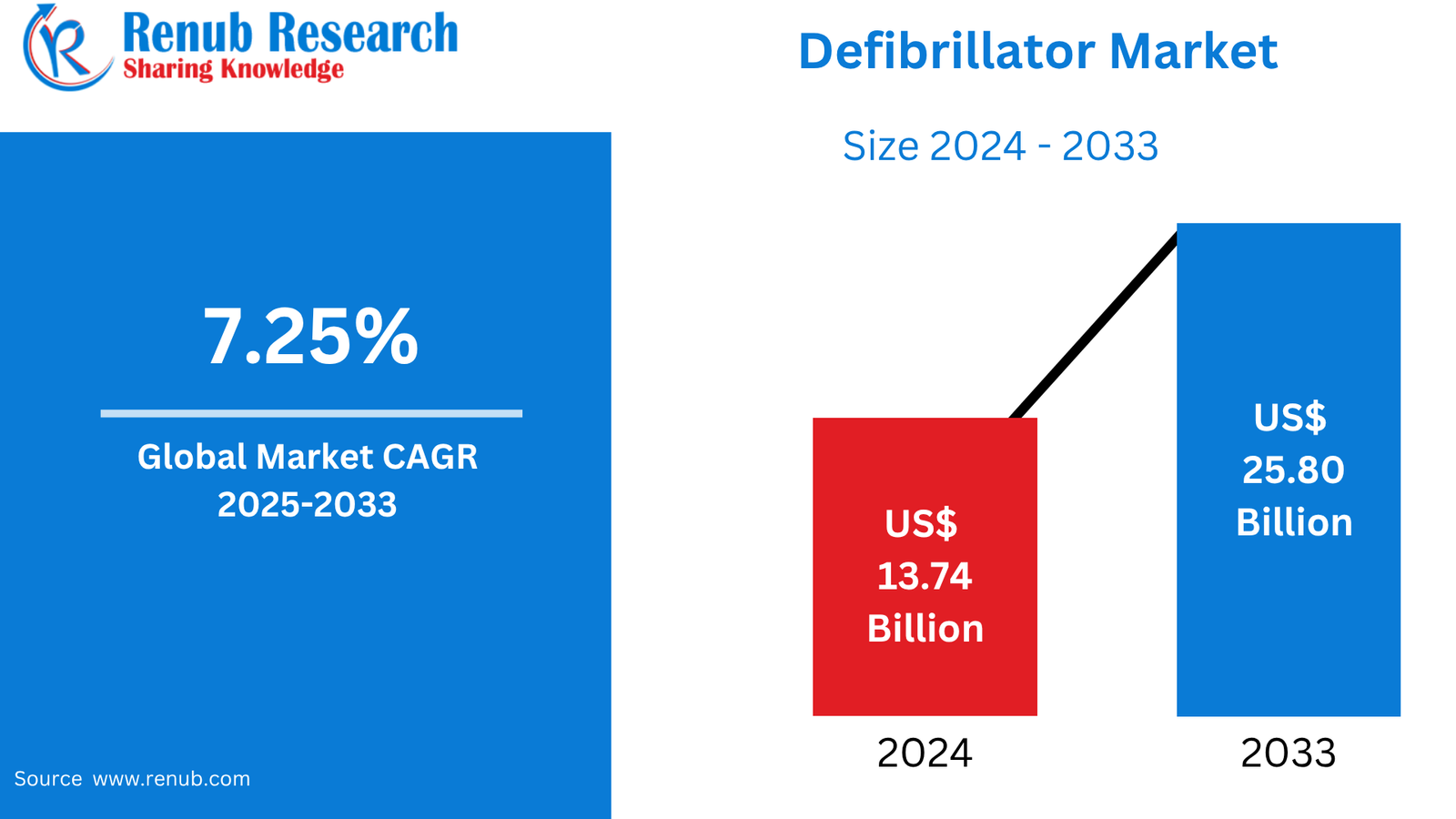
The Global Defibrillator Market is poised for robust expansion, projected to rise from US$ 13.74 billion in 2024 to US$ 25.80 billion by 2033, advancing at a CAGR of 7.25% between 2025 and 2033. Growth is primarily driven by the rising incidence of cardiac disorders such as ventricular tachycardia, arrhythmias, and coronary artery disease, alongside increasing awareness of sudden cardiac arrest and the expanding availability of public access defibrillators. Growing ambulance networks, strengthened emergency response systems, and greater clinical reliance on advanced cardiac rhythm management technologies are accelerating global defibrillator adoption.
Defibrillators play a crucial life-saving role by delivering electric shocks to restore normal heart rhythm during life-threatening cardiac irregularities. With widespread deployment across hospitals, ambulances, emergency response units, corporate environments, airports, schools, railway facilities, malls, and public spaces, defibrillators contribute significantly to improving survival outcomes in sudden cardiac arrest cases. The two primary categories—Automated External Defibrillators (AEDs) used by lay responders, and manual/advanced defibrillators, primarily used by medical professionals—collectively support critical emergency care pathways worldwide. Increasing technological sophistication, enhanced device accessibility, AI integration, remote monitoring capabilities, and wearable defibrillator innovations are further amplifying market momentum.
Download Free Sample Report:https://www.renub.com/request-sample-page.php?gturl=defibrillator-market-competitive-landscape-p.php
Competitive Landscape and Leading Defibrillator Manufacturers
The global market is dominated by leading medical technology innovators with strong clinical credibility, advanced engineering capabilities, regulatory approvals, and extensive worldwide distribution footprints.
Medtronic Plc – Global Leader in Cardiac Rhythm Management
Founded in 1949 and headquartered in Ireland, Medtronic stands as one of the most influential players in cardiac rhythm management and implantable defibrillator technologies. The company develops highly advanced implantable cardioverter defibrillators (ICDs), cardiac resynchronization therapy defibrillators (CRT-Ds), and life-sustaining cardiac care devices designed to improve survival outcomes and quality of life. With strong operational footprints across North America, Europe, Asia Pacific, the Middle East, Africa, and the Americas, Medtronic collaborates closely with hospitals, government healthcare networks, clinics, and academic institutions. Its innovation strength, diversified cardiovascular product portfolio, and continuous research investment position Medtronic as a front-runner in the evolving global defibrillator ecosystem.
Boston Scientific Corporation – Strong Expertise in Advanced Cardiac Devices
Founded in 1979 in the United States, Boston Scientific is a major global provider of cardiology, electrophysiology, and medical device technologies. The company’s defibrillator solutions are widely used in managing arrhythmias, heart failure, and life-threatening cardiac emergencies. Boston Scientific is recognized for its technological depth in ICDs, CRT devices, advanced ablation technologies, and electrophysiology solutions, supporting both preventive and emergency cardiac care. Its strong R&D investment, large installed base, expanding partnerships, and clinical excellence underpin its dominant market standing.
Note: The automotive apparel content you may have seen elsewhere associated with Boston Scientific is unrelated; the correct profile is as reflected here—purely focused on medical technology.
Philips Healthcare – Global Pioneer in AED and Clinical Care Systems
Established in 1891 and headquartered in the Netherlands, Philips Healthcare plays a transformational role in emergency medical technology and defibrillator innovation. Philips provides one of the most widely recognized AED portfolios globally, alongside professional defibrillators used in hospitals and emergency response services. The company’s AI-enabled healthcare technologies, integrated patient monitoring systems, imaging innovations, and connected care infrastructure reinforce its leadership in advanced cardiac care. Philips’ strong international presence across Europe, North America, and Asia strengthens its global influence in the defibrillator sector.
Nihon Kohden Corporation – Excellence in Cardiac Monitoring and Emergency Care
Founded in 1951 in Japan, Nihon Kohden specializes in high-precision medical electronic devices, including defibrillators, ECG machines, patient monitoring systems, and diagnostic instruments. Its defibrillators are known for reliability, durability, and advanced clinical features, supporting emergency and hospital-based cardiac care. With strong global export capabilities, Nihon Kohden meets diverse medical needs across multiple continents while contributing meaningfully to both acute care and long-term cardiac management systems.
Asahi Kasei Corporation / ZOLL Medical – Advancing Wearable and Emergency Defibrillation
Asahi Kasei, through its subsidiary ZOLL Medical, plays a significant role in wearable defibrillator technology, resuscitation devices, and emergency cardiac response systems. ZOLL’s LifeVest wearable defibrillator has transformed non-invasive cardiac protection, providing continuous patient monitoring and real-time intervention capability for at-risk individuals awaiting implantable devices.
As a clarification, the unrelated lifestyle retail content occasionally seen under Asahi Kasei in other contexts is incorrect. Asahi Kasei’s relevant healthcare arm is ZOLL Medical, which is a key defibrillator innovator.
Stryker Corporation – Strength in Emergency Response Defibrillators
Founded in 1941 and headquartered in the United States, Stryker is a prominent global healthcare technology provider. Its emergency medical equipment, including defibrillators, plays a vital role in pre-hospital emergency care, critical care environments, and hospital settings. The company’s strong supply network, stable manufacturing capacity, and robust product dependability enhance its competitiveness in global emergency cardiac care markets.
New Product Launches Strengthening Market Growth
Technological advancements continue to elevate the defibrillator industry. Abbott’s introduction of the TactiFlex™ Sensor Enabled™ Ablation Catheter in 2025 supports improved atrial fibrillation management through precision cardiac ablation. Meanwhile, Philips’ AI-enabled CT 5300 system and helium-free MRI innovations enhance diagnostic environments supporting cardiac care pathways, indirectly strengthening the broader cardiac ecosystem supporting defibrillator usage.
Strategic SWOT Insights – Key Market Players
LivaNova PLC – Strength
LivaNova demonstrates excellence in long-life implantable defibrillators and cardiac resynchronization devices, supported by energy-efficient engineering, durable battery performance, innovative arrhythmia detection algorithms, and strong regulatory approvals. This strengthens patient outcomes, reduces replacement frequency, and enhances healthcare cost efficiency.
ZOLL Medical – Opportunity
ZOLL has significant expansion prospects in wearable defibrillators and remote monitoring ecosystems. Rising cardiac risk prevalence, supportive reimbursement environments, and increasing interest in telemedicine strengthen long-term wearable adoption opportunities, enabling recurring revenue through monitoring services and data-driven cardiac management.
Recent Strategic Developments
BIOTRONIK SE & Co. KG expanded accessibility through partnerships enhancing cardiovascular device offerings across interventional care facilities. Meanwhile, MicroPort Scientific Corporation strengthened its regional presence through a strategic manufacturing partnership in India to scale cardiac rhythm management technology deployment and improve accessibility in emerging markets.
Sustainability and Industry Responsibility
Sustainability considerations are increasingly shaping corporate strategies in the defibrillator sector. ZOLL Medical is pursuing ambitious carbon neutrality objectives aligned with NHS Net Zero initiatives, implementing structured emissions monitoring across operational, transportation, and supply chain dimensions. Bexen Cardio and CU Medical emphasize corporate responsibility, workforce advancement, and long-term sustainable growth frameworks, positioning themselves as socially responsible emergency medical device innovators.
Market Intelligence and Strategic Evaluation Scope
Comprehensive defibrillator market research spans:
• Historical growth patterns
• Forecast analysis
• Market share and competitive benchmarking
• Corporate strategic developments
• Sustainability assessments
• Product portfolio and quality evaluations
• SWOT and revenue analysis
• Innovation mapping and device evolution trajectories
Major Companies Covered in Global Defibrillator Market Analysis
Medtronic Plc
Boston Scientific Corporation
Philips Healthcare / Koninklijke Philips N.V.
Nihon Kohden Corporation
Asahi Kasei Corporation / ZOLL Medical
Stryker Corporation
Abbott
LivaNova PLC
BIOTRONIK SE & Co. KG
MicroPort Scientific Corporation
Cardiac Science Corporation
Bexen Cardio
CU Medical Systems
Future Outlook—Defibrillator Market Poised for Transformational Growth
The global Defibrillator Market is set for sustained expansion driven by rising cardiac disease prevalence, increasing investment in emergency response infrastructure, continuous innovation in implantable and wearable cardiac devices, public accessibility initiatives, and stronger healthcare awareness. AI integration, wireless monitoring, data analytics, cloud connectivity, and telehealth-enabled cardiac care ecosystems will profoundly shape future market dynamics. With public health systems prioritizing life-saving cardiac technologies, defibrillators will remain indispensable components of global emergency medical frameworks, ensuring improved cardiac survival outcomes and strengthening healthcare resilience worldwide.
