

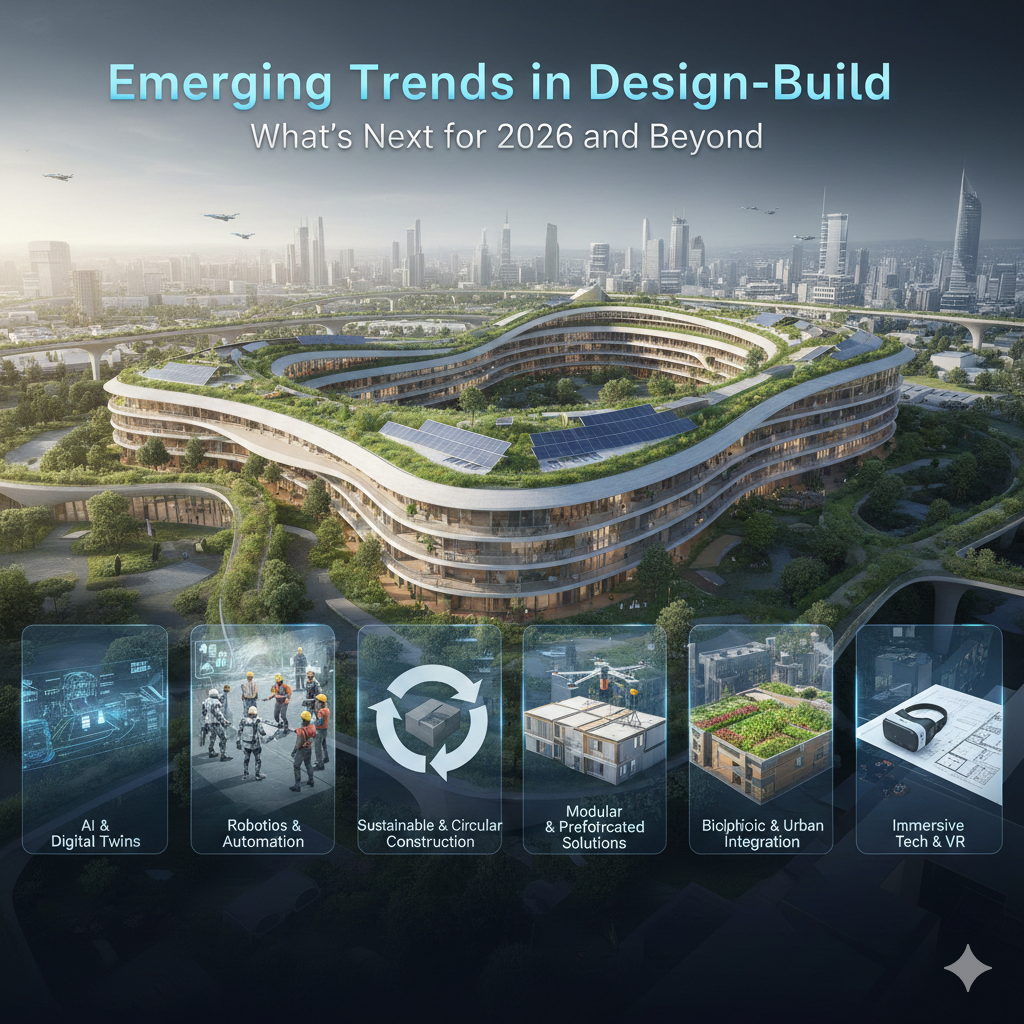
The design-build industry is moving into a new era of technology, innovation, and integrated project delivery. As the demand for faster construction timelines and cost-efficient solutions increases, design build contractors are becoming invaluable partners for clients looking to streamline their projects. In 2026 and beyond, these contractors will continue reshaping how commercial construction services operate through smarter tools, leaner methods, and more sustainable approaches.
This shift is driven by modern client expectations, evolving building codes, and groundbreaking technology. With these forces at play, it’s clear that the future of design-build will be more collaborative, efficient, and environmentally focused.
Rising Demand for Integrated Commercial Construction Services
One of the biggest changes in the industry is the increasing need for integrated commercial construction services. Clients today prefer unified teams who can design, plan, and build without relying on multiple external agencies. This reduces communication errors, speeds up delivery timelines, and improves cost predictability.
Shift from traditional delivery models
Traditional design-bid-build models often lead to miscommunication, project delays, and inflated costs. By contrast, the design-build model allows for real-time coordination between architects, engineers, and builders—creating a single, aligned workflow.
Benefits of streamlined integration
- Greater cost transparency
- Faster decision-making
- Improved accountability
- Reduced project conflicts
- More efficient use of resources
AI-Driven Project Planning & Automation
Artificial intelligence has begun transforming many industries, and construction is no exception. In 2026, AI will become a core part of design-build workflows.
Predictive analytics for cost & scheduling
AI tools can examine past data to forecast budget issues, labor shortages, or potential scheduling conflicts before they occur. This gives design build contractors the power to prevent problems rather than respond to them.
Automation tools for contractors
- BIM-integrated AI tools
- Digital twin simulation for structural testing
- Drones for real-time data collection
- Robotics for repetitive tasks
These innovations will redefine how commercial construction services deliver accuracy and speed.
Sustainable & Net-Zero Construction Innovations
Sustainability is no longer a luxury, it’s a requirement. Governments and corporations worldwide are pushing toward net-zero targets, and construction firms must adapt.
Material innovations shaping the future
New environmentally friendly materials will revolutionize design-build:
- Carbon-neutral concrete
- Recycled steel frames
- Sustainable insulation alternatives
- Eco-friendly composites
Smart energy systems in commercial construction
Future buildings will integrate:
- Solar energy grids
- Smart HVAC systems
- IoT-based energy management
- Automated lighting solutions
These additions not only reduce environmental impact but also lower long-term operating costs.
Modular & Off-Site Fabrication Growth
Modular construction continues to grow as one of the fastest, most cost-effective building methods.
Faster build timelines with precision manufacturing
By creating sections of a building off-site, contractors can cut project timelines by up to 50%. This also reduces waste, enhances quality control, and protects materials from weather-related damage.
Impact on contractor workflows
Design build contractors will need to adapt by:
- Learning modular engineering techniques
- Coordinating off-site logistics
- Integrating digital planning tools
Advanced BIM & Digital Twin Technologies
Building Information Modeling (BIM) has already transformed the industry, but the next generation of digital tools will take it further.
Real-time collaboration for project teams
Cloud-based BIM will allow for:
- Instant updates to project plans
- Error detection
- Detailed coordination across disciplines
Digital twins for lifecycle management
Digital twins help contractors simulate building performance from concept to final use, improving safety, efficiency, and long-term durability.
Enhanced Safety Through Smart Tech
Safety remains one of the biggest concerns in construction, and new tech innovations are helping minimize risk.
AI-powered safety monitoring
AI can scan the job site for hazards, identify behavior risks, and provide alerts to workers.
Robotics for hazardous tasks
Robots now handle tasks such as:
- Welding
- Drilling
- Heavy lifting
- Working in confined spaces
These improvements make commercial construction services safer than ever.
Client-Centric Customization & Flexibility
Clients increasingly want buildings that reflect their unique needs.
Increasing demand for adaptable spaces
Examples include:
- Hybrid office layouts
- Multi-purpose rooms
- Flexible floor systems for easy reconfiguration
Co-creation with end-users
More design-build firms are involving clients in every stage of development, from early sketches to 3D walkthroughs.
Growing Adoption of Public-Private Partnerships (P3s)
Governments worldwide are partnering with private companies on infrastructure projects.
Opportunities for design build contractors
- Roads
- Bridges
- Airports
- Healthcare facilities
Challenges
- Complex risk-sharing
- Stricter compliance requirements
- Long-term maintenance obligations
The Changing Role of Contractors in a Tech-Forward Era
Design build contractors will need to evolve to keep up with emerging tech trends.
Need for digital competency
Future contractors must be skilled in:
- BIM
- AI analysis
- Smart construction tools
- Cloud collaboration platforms
Collaborative leadership
Team leaders must be excellent communicators who coordinate various roles smoothly.
Key Challenges Facing Design-Build in 2026 and Beyond
Managing project cost volatility
Material prices continue fluctuating due to global economic changes. Contractors must use forecasting tools to prepare for price swings.
Addressing skilled labor shortages
The construction industry faces a labor gap. Training programs, automation, and apprenticeships will help bridge this divide.
FAQs About the Future of Design-Build
1. What makes design-build more efficient than traditional construction?
It integrates all project phases under one team, reducing communication issues and delays.
2. How are design build contractors using AI?
They use AI for scheduling, cost prediction, site monitoring, and automated equipment operation.
3. Are modular buildings durable?
Yes. Modular components often undergo stricter quality control than on-site builds.
4. How does BIM improve commercial construction services?
BIM offers real-time, accurate 3D models that reduce errors and enhance collaboration.
5. Are sustainable materials more expensive?
Some are, but long-term operational savings often outweigh initial costs.
6. Will robotics replace human workers?
Robots assist with repetitive or dangerous tasks, but skilled human oversight remains essential.
What Lies Ahead for 2026 and Beyond?
The design-build sector is on the cusp of major transformation. With advancements in AI, sustainability, modular construction, and digital modeling, design build contractors are taking on new roles as innovators and technology leaders. Meanwhile, commercial construction services are becoming more integrated, efficient, and environmentally focused.
The next decade promises smarter buildings, faster delivery systems, and more collaborative project environments. Companies that embrace these trends early will set the standards for construction excellence in 2026 and beyond.
