

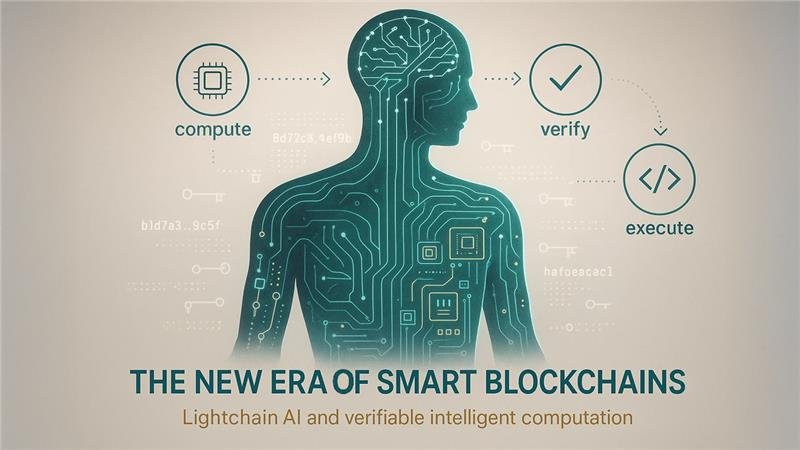
For years, blockchain has been stuck with the same reputation: slow, rigid, and expensive. Meanwhile, AI has been racing ahead, reinventing everything from logistics to creative work. But now something interesting is happening at the intersection of these two worlds — a shift from blockchains as passive record-keepers to active computational layers.
This is where Lightchain AI shows up with a bold question:
Can decentralized consensus itself become a source of intelligent computation?
It’s not just a technical puzzle. It’s a possible turning point for the entire blockchain ecosystem.
The Pain Point: Blockchains Record, AI Computes — But They Rarely Talk
Traditional blockchains excel at one thing: agreement. They allow a network of strangers to trust the same version of data without a central authority.
But they’re terrible at something else: compute.
- AI needs fast, flexible processing.
- Blockchains rely on slow, redundancy-heavy consensus.
This mismatch creates a gap. The moment a project wants on-chain AI inference, it runs into:
| Problem | Why It Happens |
| High fees | Every node repeats the same computation |
| Low throughput | Consensus has to confirm each small step |
| Limited model sizes | On-chain storage is too expensive |
| Slow iteration | Each upgrade needs governance or a hard fork |
Developers solve this by moving AI off-chain, but that introduces trust issues. You’re back to the same centralization you were trying to escape.
Enter Lightchain AI: A New Way of Thinking About Consensus
Instead of forcing AI onto blockchains, Lightchain AI flips the idea:
What if consensus becomes the compute engine?
That sounds abstract, but it’s built on three core ideas:
1. Lighter Consensus, Faster Computation
Lightchain AI reduces redundant work across nodes. Instead of all nodes repeating the same heavy computation, it strategically distributes tasks.
Consensus becomes more like coordination — less duplication, more smart partitioning.
2. AI Models Become Verifiable Functions
In the Lightchain AI framework, AI outputs can be validated without re-running the entire model. This turns machine learning inference into something closer to a mathematical proof rather than a trust-based guess.
3. The Network Learns Over Time
The system doesn’t just confirm data; it evolves.
Models can improve based on network feedback while still maintaining deterministic, verifiable structure.
If the idea works at scale, decentralization gains something it never had before: intelligence.
Why This Matters Now (and Not Five Years Ago)
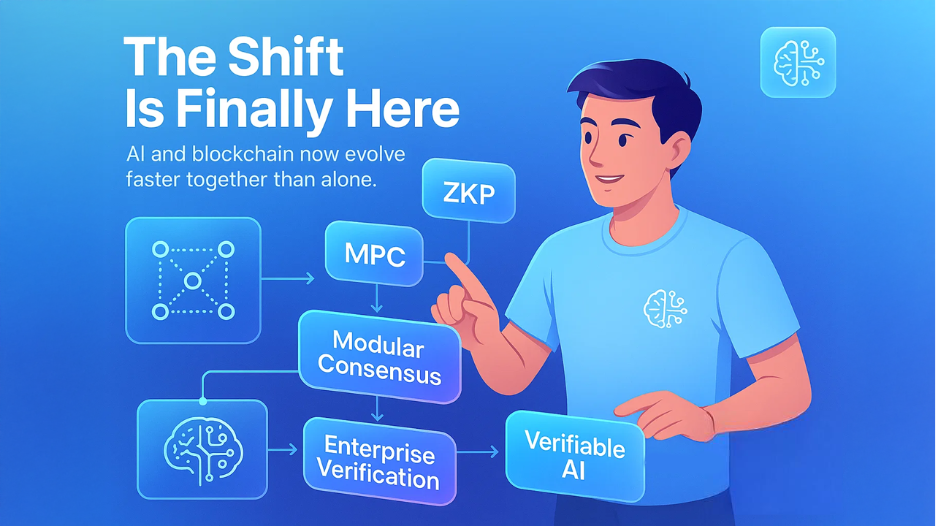
AI models are growing faster than hardware can keep up with. Meanwhile, blockchains are trying to become more efficient without sacrificing decentralization.
You now have:
- Zero-knowledge proofs that make verifying computation cheaper than doing it
- Multi-party computation that can securely split tasks
- New consensus layers optimized for modular architectures
- Demand from enterprises for verifiable AI decisions
Five years ago, the infrastructure wasn’t ready.
Today, the timing is perfect.
So What Does Lightchain AI Actually Enable?
Here are three clear use cases where the technology isn’t just promising — it’s practical.
1. On-Chain AI Agents That Can Actually Run
Most “AI agents” in web3 are marketing fluff.
They respond to prompts but do nothing trustlessly.
With Lightchain AI, agents can:
- Execute tasks with verifiable logic
- Pull data on-chain without central intermediaries
- Trigger smart contracts based on validated inference
This turns them into real autonomous agents, not chatbots sitting next to a blockchain.
2. Decentralized AI Marketplaces That Don’t Rely on Blind Trust
Model sellers can publish inference functions directly on the network.
Buyers don’t trust the seller — they trust the cryptographic verification.
This unlocks:
- Pay-per-inference models
- Community-owned datasets
- Model calibration monitored by the network
And because the verification is lightweight, the marketplace doesn’t collapse under gas fees.
3. Smarter Decentralized Applications Built on Predictive Logic
Imagine:
- A lending protocol adjusting rates based on verified predictive risk
- A supply-chain network running real-time optimization
- A decentralized identity system that validates behavioral signals without revealing personal data
With Lightchain AI, these aren’t sci-fi.
They’re natural evolutions of what the tech makes possible.
Why Developers Are Paying Attention
Even without hype, builders see the strategic advantages:
| Advantage | Impact |
| Lower cost per computation | Makes advanced AI models usable on-chain |
| Verifiable inference | Eliminates “trust-me” middlemen |
| Modular design | Works with existing ecosystems (EVM, WASM, etc.) |
| Upgradable frameworks | No need for endless hard forks |
This aligns with where the industry is heading: modularity, verifiability, and efficiency.
The Hard Truth: This Won’t Be Easy
A forward-looking perspective means being honest.
Lightchain AI still needs to overcome:
- The complexity of distributed model versioning
- The risk of network fragmentation if nodes specialize too much
- The unpredictability of regulatory frameworks around AI inference
But here’s the reality: everything ambitious starts with friction.
The bigger question is whether the direction is right — not whether the road is smooth.
A Glimpse of the Future: When Consensus Becomes a Cognitive Engine
If Lightchain AI succeeds, blockchains stop being ledgers.
They become thinking systems.
Not AGI. Not consciousness.
But verifiable, distributed intelligence that can:
- Interpret data
- Make decisions
- Trigger actions
- Improve over time
- Stay trustless
This would push the entire decentralized world past simple record-keeping and into adaptive, intelligent coordination.
That’s the real shift — and it’s bigger than any single protocol.
Final Takeaway
Lightchain AI isn’t offering a faster chain or a clever new model.
It’s offering a different paradigm:
Consensus doesn’t just secure data — it can compute and reason.
If this vision holds, decentralization evolves from a passive safety mechanism into an active intelligence layer.
And the next generation of decentralized applications won’t just store information.
They’ll understand it.
Lightchain AI stands at the edge of that transformation, asking a question that can reshape the industry:
What happens when the chain starts to think?
Related Post:
