

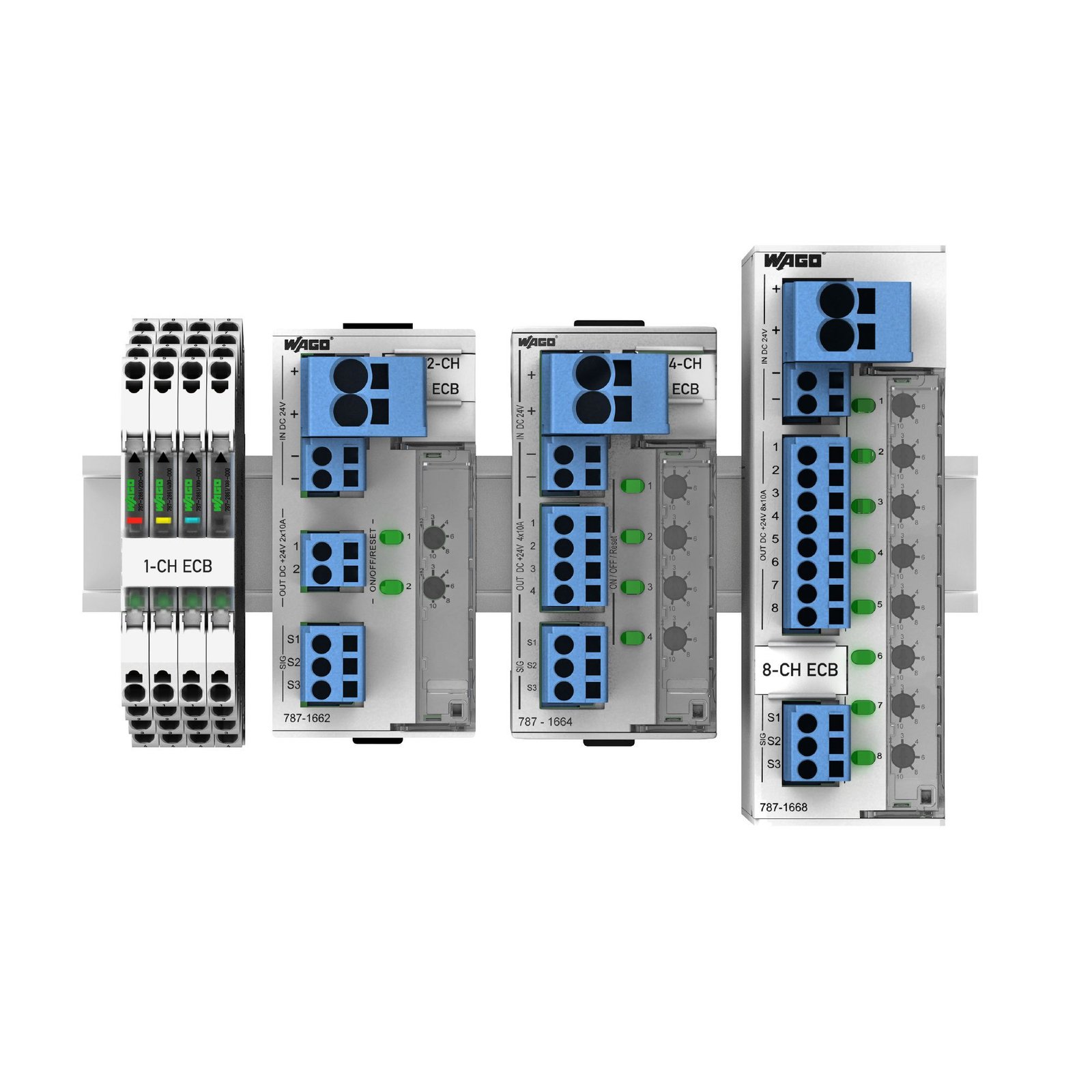
Introduction: Protection Challenges in DC Power Systems
DC microgrids are becoming increasingly popular for industrial automation, renewable energy systems, and data center applications. However, protecting these systems poses unique challenges. Unlike AC, DC fault currents rise extremely fast and do not have a natural current zero crossing. This means that once a short circuit occurs, the current can continue to flow unchecked unless it is actively interrupted. Traditional mechanical breakers, designed primarily for AC systems, often struggle to react quickly enough to these high-speed DC faults. Overcurrent protection can be delayed, resulting in equipment damage, thermal stress, or even fire hazards.
This is where electronic circuit breakers (ECBs) come into play. They provide fast, controlled isolation of faulty segments in DC systems, making them essential for safe and reliable microgrid operation. By combining speed, precision, and flexibility, ECBs ensure that DC networks can operate efficiently without risking system collapse.
What Are Electronic Circuit Breakers?
Electronic circuit breakers differ fundamentally from traditional mechanical breakers. At their core, ECBs rely on microcontroller-based trip logic that continuously monitors current and voltage. High-speed sensing ensures that any overcurrent or short-circuit condition is detected within milliseconds.
Some ECBs are fully solid-state, using power semiconductors to interrupt the current directly. Others are hybrid designs that combine rapid electronic detection with mechanical contacts for additional robustness.
Internally, these breakers use sensing architectures like shunt resistors, Hall-effect sensors, and digital trip units optimized specifically for DC environments. This allows them to react with precision even in systems with long cable runs or small conductor cross-sections, minimizing false trips while providing reliable protection at the same time.
With the ability to set nominal current levels for each channel, ECBs can manage both low and high-capacity loads without compromising safety. Advanced designs even support active current limitation, preventing overloads during sudden surges, such as switching high-capacitance loads above 50,000 µF.
Role in DC Microgrid Architectures
In a DC microgrid, electronic circuit breakers are more than just safety devices-they are integral components of the network. ECBs interface directly with DC busbars, converters, and energy storage systems, ensuring that any fault is quickly isolated without affecting the entire system.
Many modern ECBs can be configured remotely, allowing engineers to adjust protection parameters like current thresholds or trip delays. While these breakers communicate status and events over industrial network switches, it is important to note that these switches serve as a communication backbone, not a power routing system. By integrating with networked monitoring systems, ECBs provide actionable data that helps operators maintain microgrid reliability.
How They Improve DC Grid Stability
- Selective Load Shedding: Electronic circuit breakers can turn off non-critical loads first, keeping important devices running during faults. This prevents the whole system from shutting down.
- Adaptive Trip Settings: Breakers can adjust their response based on changes in load or energy generation, such as fluctuations in solar panels or battery output.
- Better Fault Localization: Instead of cutting power to the entire DC bus, ECBs isolate only the faulty segment. This keeps the rest of the network running smoothly and reduces downtime.
Data-Driven Power Monitoring
ECBs also provide valuable data for microgrid management. Dashboards can display DC current, bus voltage, breaker state, and trip history, giving operators a clear view of system health. Energy flow profiling across feeders and loads enables better capacity planning, while predictive maintenance can identify potential issues in semiconductor switches, thermal cycling, or abnormal switching patterns before they cause failure.
By combining protection with monitoring, ECBs transform from simple safety devices into tools that improve operational efficiency, reduce maintenance costs, and extend equipment life.
Use Cases Across DC Applications
Electronic circuit breakers are widely used across various DC applications. Industrial DC microgrids, including robotics, automation cells, and warehouse systems, rely on ECBs to maintain uptime and prevent costly downtime.
Renewable energy systems, particularly solar DC distribution networks and battery energy storage, benefit from the fast fault isolation ECBs provide. Data centers adopting 380 V DC architectures also leverage ECBs to minimize conversion losses and maintain high availability for critical loads. In all these cases, integrating ECBs ensures safe, efficient, and resilient DC operation.
Future of DC Protection Systems
Looking ahead, DC protection systems are evolving to be more rule-based and adaptive. Feeder reconfiguration can occur autonomously based on predefined protection schemes, ensuring continued operation even when faults occur. Digital twin-based simulations allow engineers to validate DC fault scenarios in a virtual environment, improving system design and safety without relying on real-time AI control.
As DC microgrids expand in industrial and commercial applications, electronic circuit breakers will remain central to ensuring safe, stable, and data-driven operations. Their combination of fast response, selective protection, and integration with industrial network switches makes them indispensable for modern DC architectures.
