
Catheters Market Size and Forecast 2025–2033
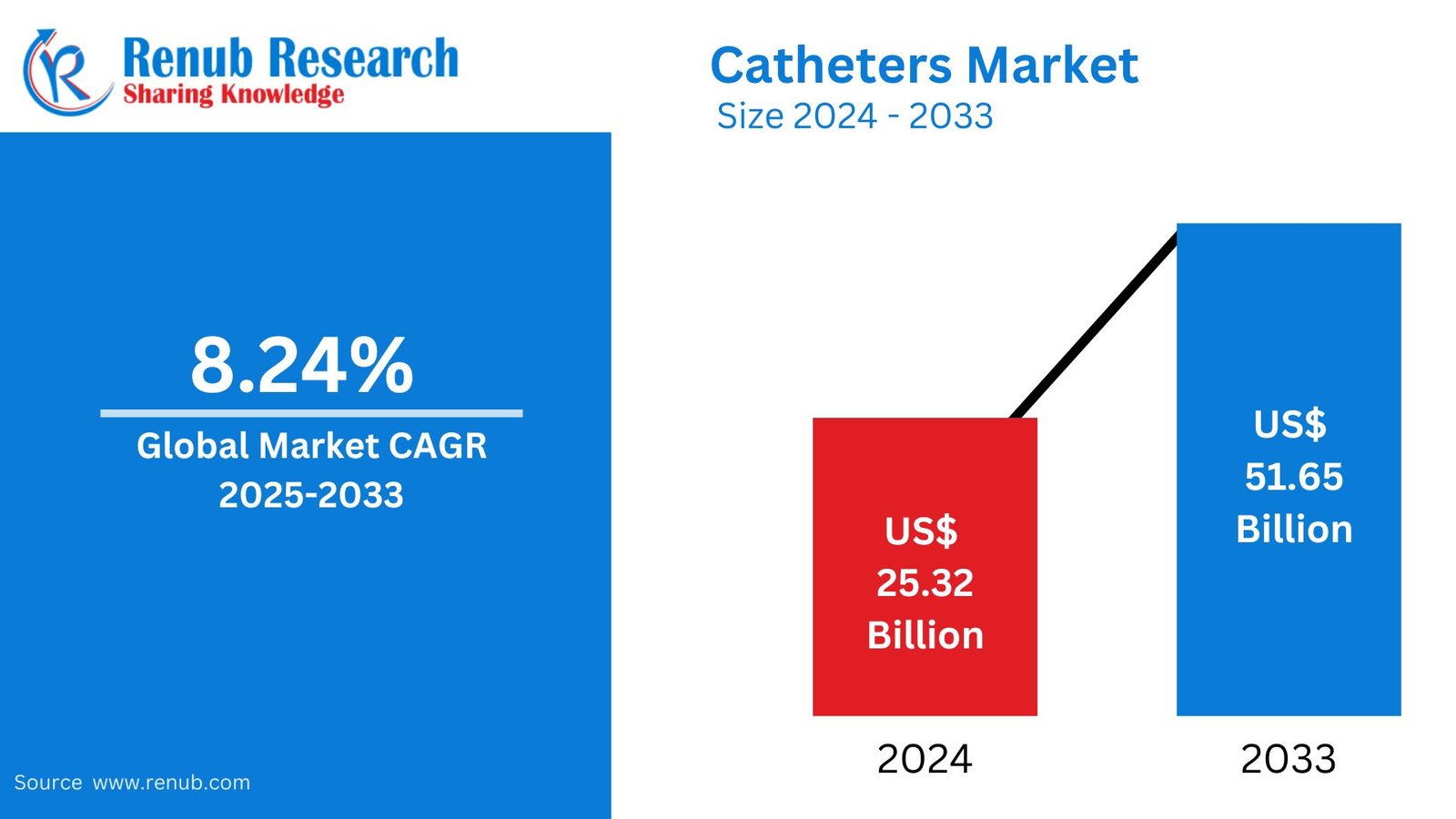
According to Renub Research global catheters market is experiencing strong growth momentum, driven by rising chronic disease prevalence, expanding healthcare infrastructure, technological advancements, and increasing demand for minimally invasive procedures. Valued at USD 25.32 billion in 2024, the global catheter market is projected to reach USD 51.65 billion by 2033, expanding at a CAGR of 8.24 percent between 2025 and 2033. As aging populations continue to grow worldwide and healthcare systems prioritize efficient treatment outcomes, catheters remain an essential component of modern medical care across cardiovascular, urinary, neurological, oncology, and renal treatment applications.
Global Catheters Market Overview
Catheters are flexible medical devices inserted into the body for drainage, fluid administration, diagnostic monitoring, and therapeutic procedures. Commonly manufactured using materials such as silicone, rubber, or high-performance medical plastics, catheters are designed to support internal access through the urethra, blood vessels, or surgical entry points. They are indispensable in critical care, surgical procedures, cardiovascular interventions, dialysis treatments, oncology drug delivery, and intensive care monitoring systems.
In urinary care, catheters support patients suffering from urinary retention, neurological bladder dysfunction, or undergoing major surgery. In cardiovascular healthcare, they enable advanced diagnostic and interventional procedures including angiography, electrophysiology, and balloon angioplasty. In nephrology, dialysis catheters are vital for kidney failure patients requiring hemodialysis. In addition, catheters facilitate fluid delivery during chemotherapy, anesthesia administration, and surgical management, reinforcing their central role in improving patient care outcomes worldwide.
Download Free Sample Report:https://www.renub.com/request-sample-page.php?gturl=catheter-market-p.php
Key Growth Drivers in the Global Catheters Market
Rising Prevalence of Chronic Diseases
A primary factor propelling catheter market growth is the increasing global burden of chronic diseases. Conditions such as cardiovascular disorders, diabetes, chronic kidney disease, and cancer require frequent medical interventions where catheters play a critical role. Cardiovascular diseases alone account for approximately 18 million deaths annually, while millions more require continuous monitoring and interventional procedures. Kidney disease prevalence continues to climb, significantly increasing dialysis catheter usage. As life expectancy rises globally, the need for long-term catheter-based treatments and monitoring further accelerates demand.
Rapid Advancements in Catheter Technologies
Technological innovation is significantly transforming catheter design, safety, and functionality. New-generation catheters are more flexible, biocompatible, and durable, reducing complications and improving patient recovery experiences. Developments in antimicrobial coatings help minimize infection risk, while bioabsorbable and precision-control catheter technologies enhance procedural efficiency. The introduction of advanced balloon catheters, electrophysiology catheters, and digital-integrated solutions enables improved diagnostics, therapeutic accuracy, and patient safety. For example, recently introduced balloon guide catheters support enhanced clot removal and reduce embolic risk, reflecting the industry’s shift toward smarter, safer devices.
Growing Preference for Minimally Invasive Procedures
Modern healthcare trends increasingly emphasize minimally invasive treatments that reduce surgical trauma, shorten hospital stays, and support faster recovery. Many minimally invasive techniques rely heavily on catheter-based access systems to deliver treatment, diagnostic tools, and medication. With millions of minimally invasive procedures performed annually worldwide, the demand for advanced catheter systems continues to rise across cardiovascular surgery, oncology, urology, and orthopedics. As hospitals and surgical centers expand adoption of minimally invasive technologies, catheter usage is expected to grow substantially through 2033.
Regional Market Outlook for Catheters
Germany Catheter Market Outlook
Germany represents one of Europe’s leading catheter markets due to its sophisticated healthcare infrastructure, aging population, and strong medical technology adoption. The prevalence of cardiovascular and urological disorders creates sustained demand for urinary and vascular catheters. German manufacturers continuously advance catheter safety and design, including infection-resistant materials and enhanced biocompatibility solutions. Strong R&D capabilities and continual innovation position Germany as a strategic hub in the European catheter sector.
China Catheter Market Outlook
China is witnessing rapid catheters market expansion supported by massive healthcare investment, growing chronic disease incidence, and improving hospital infrastructure. Rising cases of diabetes, cardiovascular disorders, and kidney diseases are accelerating catheter utilization across healthcare institutions. Government initiatives to strengthen national healthcare capacity and local production capabilities further support market growth. Additionally, China’s emphasis on developing cost-efficient yet technologically advanced catheters positions it as a major producer and exporter in the Asia-Pacific region.
Brazil Catheter Market Outlook
Brazil leads the Latin American catheter market, driven by an expanding healthcare system, rising chronic disease burden, and growing demand for minimally invasive treatments. Increasing healthcare investments, improved access to medical services, and enhanced awareness of advanced treatment technologies contribute to strong market performance. Despite disparities in healthcare accessibility across regions, Brazil continues to invest in modern healthcare infrastructure and innovative catheter technologies, reinforcing its leadership in Latin America.
United Arab Emirates Catheter Market Outlook
The UAE is rapidly emerging as a key catheter market in the Middle East owing to strong investment in advanced healthcare systems, state-of-the-art hospitals, and medical tourism initiatives. High prevalence of lifestyle-related diseases such as diabetes and cardiovascular conditions contributes to rising catheter usage. The country’s strategy of adopting cutting-edge medical technologies, prioritizing patient safety, and strengthening medical infrastructure drives continuous market growth and solidifies UAE’s regional dominance.
South Africa Catheter Market Outlook
South Africa represents the most significant catheter market in Africa due to increasing chronic disease prevalence, growing awareness of modern treatment technologies, and improving healthcare infrastructure. Rising cardiovascular and renal disorders drive the need for dialysis and cardiovascular catheters. Although challenges such as unequal healthcare access remain, technological advancements, government healthcare investments, and stronger distribution networks are enhancing catheter availability and utilization across the country.
Competitive Landscape and Key Company Developments in the Catheters Market
Leading medical device companies continue to innovate and expand catheter portfolios through product launches, regulatory approvals, and strategic partnerships.
Abbott Laboratories has secured multiple regulatory approvals for advanced cardiac catheters, improving treatment effectiveness in complex cardiovascular conditions.
Becton Dickinson (BD) continues to launch infection-reducing catheter technologies and advanced vascular access systems to improve clinical outcomes and reduce complications.
Boston Scientific is expanding through strategic acquisitions and launching cutting-edge cardiac ablation and vascular treatment catheters.
Teleflex Incorporated focuses on developing enhanced vascular access systems, PICC solutions, and structural heart intervention catheters supported by strong clinical registry programs.
Medtronic plc leads with innovative cardiac ablation technologies and multifunctional electrophysiology catheter systems.
Johnson & Johnson continues strengthening its electrophysiology portfolio through acquisitions and next-generation pulsed field ablation technologies.
Edwards Lifesciences advances structural heart catheter therapies, including leading transcatheter valve intervention systems.
Stryker Corporation integrates robotics and advanced navigation systems with catheter-based surgical platforms, enhancing procedural precision.
Catheters Market Segmentation Overview
The global catheter market is segmented by product type, material, end user, application, and region. Key segments include TAVR, TMVR, and TPVR catheters; biological and mechanical tissue-based materials; and major end-user categories such as hospitals, ambulatory surgical centers, and specialty care facilities. Applications include aortic stenosis, aortic regurgitation, and various cardiac and vascular interventions. Regionally, the market spans North America, Europe, Asia-Pacific, Latin America, and the Middle East & Africa.
Future Outlook of the Global Catheters Market
The catheters market is expected to maintain strong growth through 2033 as global healthcare systems continue expanding treatment accessibility, adopting minimally invasive technologies, and addressing increasing chronic disease burdens. Innovation will remain at the forefront, with future catheter technologies expected to feature smarter coatings, enhanced biocompatibility, digital integration, robotic compatibility, and precision-driven capabilities. Strong investments in healthcare infrastructure, favorable regulatory support, rising surgical volumes, and increasing patient awareness will reinforce sustained growth.
With leading companies such as Abbott, BD, Boston Scientific, Teleflex, Medtronic, Johnson & Johnson, Edwards Lifesciences, and Stryker driving innovation and global expansion, the catheter market is positioned to remain a critical pillar of advanced medical treatment worldwide from 2025 to 2033.
