
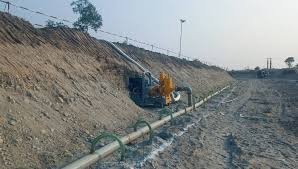
Water accumulation in industrial areas can cause several issues. In mining, sudden water inside the mine can be dangerous and life-threatening for workers. If the construction area becomes flooded with water, it can bring operations to a stop. Moreover, poor drainage in agricultural land can damage crops and reduce overall yield. A dewatering system is a complete solution to all these problems. It can drain excess water from factories, mines, and agricultural fields, ensuring smooth and efficient production. There are several types of dewatering systems available with multiple uses. Here you will get a detailed account of that. Have a look:
Wellpoint Dewatering System
At certain construction areas, the groundwater level is close to the surface. To conduct proper construction projects in these areas, factories utilise a well point dewatering system. This system consists of several small wells, connected to a dewatering pump. These wells draw out groundwater for the construction project and are effective for maintaining a stable working condition.
Deep Well System
When project sites require dewatering at greater depth, a deep well system is the most suitable method. In this system, large wells are connected to submersible pumps to draw water from deeper underground levels. This type of dewatering system is suitable for large infrastructure projects, construction sites, and mining operations. This method performs effectively with heavy water flow.
Sump Pump System
It is one of the simplest dewatering systems, where excess water is collected in a sump or pit. Then, a dewatering pump removes the water from that pit and keeps the space dry. This method is suitable for smaller construction areas, smaller agricultural fields, and basements. It is a simple and cost-effective method.
Vacuum Dewatering System
In this system, a dewatering pump applies a vacuum pressure to the soil to remove excess water. When the soil is muddy and draining water is difficult, experts follow this dewatering system to remove water. This system is effective in improving soil strength and stability, making it suitable for conducting road construction projects and other foundation work.
Horizontal Dewatering System
Horizontal drains or pipes extract additional water from construction sites or agricultural fields. In this system, experts install underground drains or pipes, allowing the soil to receive excess water again to maintain the groundwater level. It keeps the groundwater level intact and prevents soil erosion. Therefore, many construction companies follow this dewatering system, as it ensures the operation goes while maintaining sustainability.
The Final Words
Different types of dewatering systems work separately. However, the goal of each system is to remove excess water from the site and maintain the groundwater level. The soil condition of an area, the types of projects, and the groundwater level are the deciding factors in selecting a particular dewatering system.
