

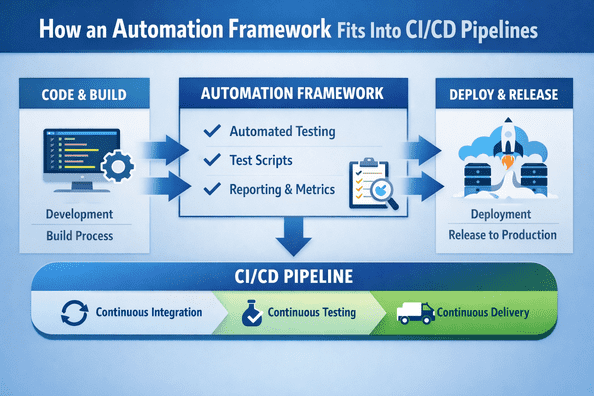
Modern software delivery depends heavily on CI/CD pipelines to enable fast, reliable releases. As code changes move rapidly from development to production, testing must keep pace without slowing teams down. This is where an automation framework becomes essential. Rather than treating tests as isolated scripts, a well-designed automation framework provides the structure needed to integrate test automation smoothly into CI/CD pipelines.
The Role of an Automation Framework in CI/CD
In CI/CD pipelines, every code change triggers automated workflows—builds, tests, and deployments. An automation framework acts as the backbone that organizes how test automation runs within these workflows. It defines how tests are structured, executed, reported, and maintained across environments.
Without a proper automation framework, test automation often becomes fragile and inconsistent. Tests may work locally but fail in CI environments, producing unreliable feedback. A framework ensures consistency by standardizing execution, configuration, and reporting across pipeline stages.
Enabling Fast and Reliable Feedback
One of the primary goals of CI/CD is fast feedback. An effective automation framework helps achieve this by supporting different layers of testing:
- Unit-level test automation for quick validation of individual components
- Integration and API tests to verify service interactions
- End-to-end tests to validate critical user workflows
By organizing tests into layers, the automation framework ensures that fast-running tests execute early in the pipeline, while slower tests run later or in scheduled jobs. This structure prevents pipelines from becoming unnecessarily slow while maintaining adequate coverage.
Supporting Scalability and Parallel Execution
As projects grow, the volume of test automation increases. An automation framework designed for CI/CD supports parallel execution, allowing tests to run across multiple agents or containers. This reduces overall execution time and keeps pipelines responsive.
Scalability also means handling multiple environments. A robust automation framework manages environment-specific configurations, test data, and credentials without requiring test code changes. This flexibility is critical for pipelines that deploy across staging, QA, and production-like environments.
Improving Test Stability and Maintainability
CI pipelines quickly expose flaky tests. An automation framework helps reduce flakiness by encouraging best practices such as:
- Clear test setup and teardown mechanisms
- Reusable utilities and helpers
- Proper handling of test data and dependencies
- Consistent assertion and reporting strategies
Well-structured test automation within a framework is easier to debug, maintain, and trust. This trust is essential—when developers lose confidence in test results, CI/CD pipelines lose their value.
Integrating Reporting and Quality Gates
An automation framework plays a key role in how test results are reported in CI/CD pipelines. Clear, actionable reports help teams understand failures quickly and decide whether a build is ready to move forward.
Frameworks often integrate with CI tools to provide:
- Pass/fail summaries
- Test execution trends
- Failure diagnostics and logs
These insights enable quality gates, where deployments proceed only if test automation results meet defined criteria. This makes the automation framework a critical part of release decision-making.
Supporting Regression Testing at Scale
Regression testing is a natural fit for CI/CD pipelines, but managing it at scale requires structure. An automation framework helps teams organize regression tests so they can be executed selectively based on changes, risk, or pipeline stage.
Modern approaches to test automation also focus on reducing maintenance overhead. Tools like Keploy complement traditional automation frameworks by generating regression tests from real system behavior, making regression coverage more aligned with production usage while still fitting into CI/CD workflows.
Aligning Test Automation With DevOps Practices
An automation framework bridges the gap between test automation and DevOps. By integrating seamlessly with build tools, version control systems, and deployment pipelines, it ensures testing is not a separate phase but an integral part of delivery.
This alignment allows teams to:
- Shift testing earlier in the pipeline
- Detect issues before deployment
- Release changes with greater confidence
Conclusion
An automation framework is a foundational component of effective CI/CD pipelines. It provides the structure, consistency, and scalability needed to integrate test automation without slowing delivery. By enabling fast feedback, supporting parallel execution, improving test stability, and strengthening regression testing, an automation framework ensures that CI/CD pipelines remain reliable and efficient. When implemented thoughtfully, it transforms test automation from a bottleneck into a powerful enabler of continuous delivery.
