
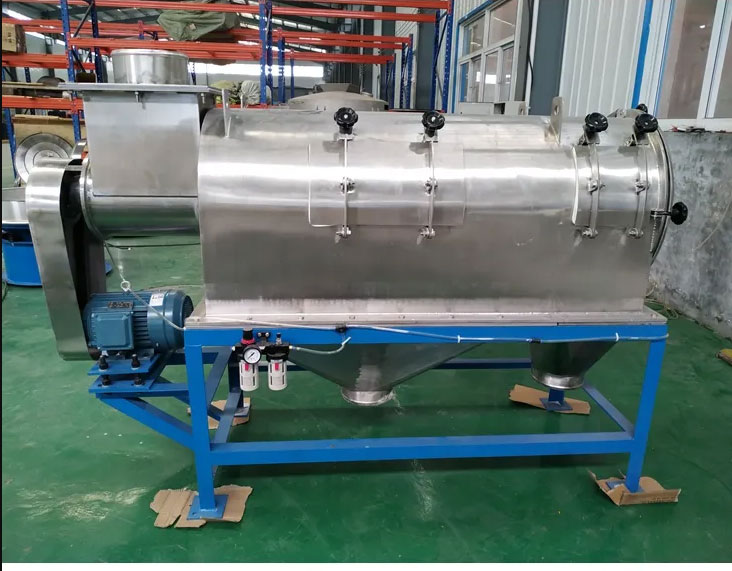
Walk through any facility that processes powders, granules, or particulate material at scale, and the round screening unit sitting in the production line usually isn’t the most exciting piece of equipment in the room. It’s also often the piece of equipment quietly determining whether the final product meets spec, whether contamination gets caught before packaging, and whether a batch passes quality control or gets flagged for rework. A Round Sifter Vibrator earns that role through a design that’s been refined for exactly this kind of work, circular screening deck, centrally mounted vibratory motor, multi-directional particle movement, and it’s worth understanding why that specific geometry matters as much as it does.
The Shape Isn’t Arbitrary
Round screening units use a circular deck with a centrally mounted vibratory motor, which creates a specific kind of motion: material spirals outward from the center toward the screen’s edge as it moves through gyratory, elliptical, or sometimes a combination of horizontal and vertical vibration patterns. This motion path matters because it maximizes the amount of time material spends in contact with the screen surface relative to the unit’s physical footprint, which directly improves separation accuracy compared to designs that move material in a straight line across a flat deck.
Rectangular or linear screeners move material in one direction, which works fine for some applications but tends to give particles less total screen contact time unless the unit is built considerably longer. A round design achieves comparable or better screening efficiency in a noticeably smaller footprint, which is part of why it’s become the standard geometry across food, pharmaceutical, chemical, and mineral processing industries handling fine to mid-range particle sizes.
Multi-Directional Motion Solves a Real Problem
Material doesn’t always behave predictably on a screen. Some particles are irregular in shape rather than perfectly round, some clump together under humidity or static charge, and some have a tendency to bridge across mesh openings rather than passing through cleanly. Unidirectional motion can struggle with these behaviors because particles moving in a single consistent direction don’t always get the repeated agitation needed to break apart clumps or reorient irregularly shaped particles toward an opening they’d actually fit through.
The gyratory, multi-directional motion of a round vibratory screener addresses this directly. As material spirals across the deck, it experiences vibration from multiple angles repeatedly rather than just one consistent push, which increases the likelihood that an irregular particle eventually presents itself to the mesh at an angle that allows correct passage. This is a meaningful part of why round units consistently outperform simpler linear designs on materials that are difficult to screen.
Where Accuracy Actually Comes From
Screening accuracy depends on more than just motion pattern, though motion pattern is foundational. Mesh tension matters considerably: a properly tensioned screen vibrates uniformly across its entire surface, while a loose or unevenly tensioned screen creates dead zones where material doesn’t experience full separation force, leading to inconsistent results across a single batch. Quality manufacturers build tensioning systems specifically designed to maintain consistent mesh tightness over extended operation, since tension naturally loosens with use and vibration over time.
Screen mesh quality and weave type also affect accuracy directly. Woven wire mesh, the most common type, comes in different weave patterns and wire diameters that affect both the actual opening size and how resistant the screen is to clogging (sometimes called blinding) when processing fine or slightly moist material. For applications screening particularly fine powders or sticky materials, anti-blinding features like ball trays beneath the screen, which use bouncing balls to dislodge material caught in the mesh, can meaningfully improve sustained accuracy over long production runs.
Amplitude and frequency tuning rounds out the accuracy picture. Heavier or denser material generally needs more vibratory force to move efficiently across the screen, while delicate or very fine material can be damaged or compacted into the mesh by excessive force. Units that allow operators to adjust amplitude and frequency independently give far more precise control over separation accuracy across different materials than fixed-setting equipment.
Industries Where This Precision Actually Matters
Pharmaceutical manufacturing depends on screening accuracy in ways that have direct regulatory consequences. Particle size distribution affects dissolution rate, bioavailability, and dosing consistency, and most regulatory frameworks require documented evidence that screening processes consistently meet specification. A round sifter with stable mesh tension and tunable vibration parameters produces the kind of repeatable, documentable accuracy that pharmaceutical quality systems require.
Food processing relies on this precision both for product consistency and food safety. Powdered ingredients like flour, sugar, and spice blends need consistent particle sizing for product quality, while screening also functions as a critical contamination control point, catching foreign material before it reaches packaging. A check screen position above the primary screen, common on quality round units, catches contaminants specifically for this purpose.
Chemical, cosmetic, and mineral processing applications depend on accurate screening for product performance reasons that vary by industry but share a common thread: particle size directly affects how a powder behaves, whether that’s how a pigment disperses, how a chemical compound reacts, or how a mineral concentrate performs in downstream processing.
Construction Details Worth Evaluating
Stainless steel construction, typically 304 or 316 grade, is standard for food, pharmaceutical, and many chemical applications because of its corrosion resistance and ease of cleaning, both directly relevant to maintaining screening accuracy over time since corrosion and material buildup degrade screen performance.
Multiple deck configurations allow a single unit to separate material into several output streams in one pass: oversize, mid-grade product, and fines, for instance, which improves both efficiency and the precision with which a batch gets graded compared to running material through a single-deck unit multiple times.
Vibration isolation and mounting quality affect long-term accuracy more than most buyers initially expect. A unit that vibrates the surrounding structure rather than isolating its vibration to the screening deck loses energy that should be going into material separation, and that energy loss tends to show up as gradually declining screening accuracy as components loosen and wear unevenly over time.
What This Means in Practice
This style of round vibratory screener earns its place in a production line not because circular equipment looks more sophisticated, but because the geometry solves real screening problems that simpler designs struggle with: better screen contact time per footprint, multi-directional motion that handles irregular and clumping particles more effectively, and a design that supports the kind of consistent, documentable accuracy that regulated industries increasingly require.
For any operation where particle size consistency directly affects product quality, regulatory compliance, or downstream processing performance, the accuracy advantage of proper round screening equipment, correctly specified for the material being processed, tends to pay for itself through reduced rework, fewer quality complaints, and more reliable compliance documentation over the life of the equipment.
